Choosing the best Smart Toilet is less about chasing the longest feature list. It is about matching technology with real bathroom habits, available space, and long-term comfort. A heated seat may feel luxurious on a cold morning. However, an oversized control panel can become frustrating in a small, shared bathroom. Water pressure, electrical access, cleaning routines, and user height deserve equal attention.
Bill Strang, a former TOTO USA executive, once offered a useful design principle: “Technology should disappear into the experience.” That idea provides a practical starting point. A reliable Smart Toilet should flush consistently, regulate water temperature smoothly, and offer controls that guests understand quickly. It should also include accessible maintenance points, clear warranty terms, and replacement parts that remain available.
Look closely at the details.
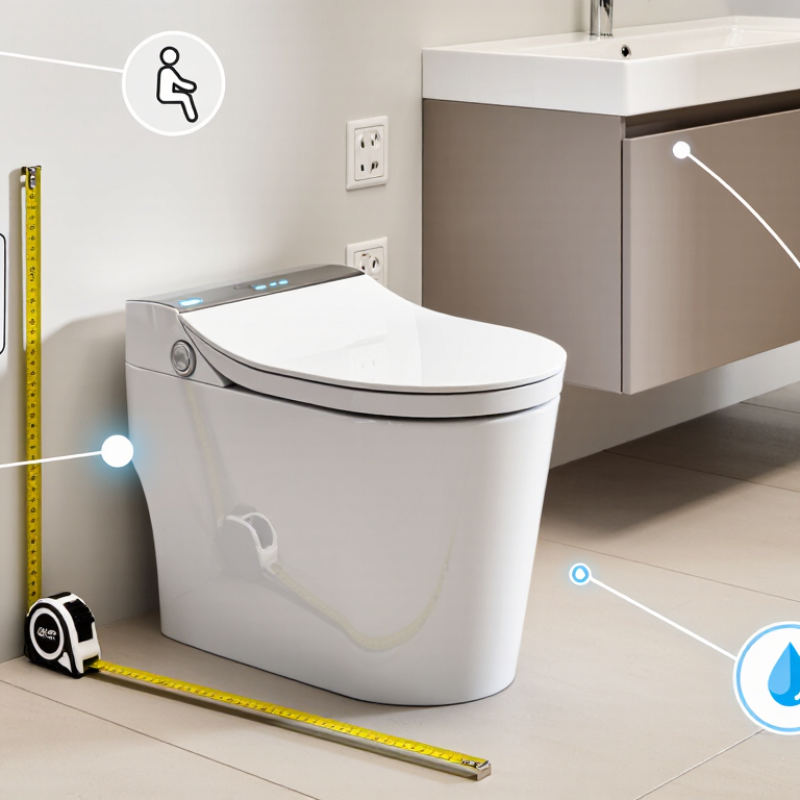
Check the bowl shape before admiring the remote. Sit on the model, if possible. Notice whether the lid feels stable and whether the seat fits your posture. Measure the rough-in distance, outlet location, and door clearance. A beautiful unit can fail if the bathroom cannot support it.
Certifications and independent reviews add confidence, but they do not replace judgment. Some product claims sound impressive yet offer little daily value. Night lighting might help at 2 a.m.; a complicated app may not. Even experienced buyers can overlook installation costs, filter replacement, or local service coverage. That is the uncomfortable part: the “best” Smart Toilet is rarely universal. It is the model that performs quietly, safely, and comfortably in your own room.
How to Choose the Best Smart Toilet for Your Bathroom?
Smart toilets usually fall into three types: integrated units, smart seats, and wall-hung models. Integrated toilets combine the bowl, bidet system, controls, and flushing technology. Smart seats upgrade an existing toilet, often with lower installation costs. Wall-hung models save floor space, but they require a strong concealed frame and careful plumbing work.
Functions should match daily habits, not just appear impressive. Useful options include adjustable water temperature, heated seating, warm-air drying, night lighting, automatic flushing, and odor control. Some models also offer user presets and self-cleaning nozzles. A dryer may sound useful, yet some households rarely use it. More features can also mean more maintenance.
Bathroom compatibility deserves careful attention. Measure the rough-in distance, bowl clearance, door swing, and water connection before ordering. Measure twice. Power matters. Confirm that a grounded outlet is safely positioned and protected from moisture. Check local electrical and plumbing requirements, especially for wall-hung installations. Water pressure and drainage capacity can affect performance. A licensed professional should verify hidden pipes and structural support. Safety certification from a recognized testing body is also worth checking. A feature-rich toilet can still be a poor choice if its seat feels cramped or replacement parts are difficult to obtain.
Typical function availability by smart toilet type. A score of 1 means the function is commonly built into that type; 0 means it is generally not included as standard.
Bathroom compatibility: Choose an electronic bidet seat when you want to upgrade an existing toilet with limited remodeling. Choose an integrated smart toilet when you have suitable electrical and water connections and enough space for a complete replacement. Check the toilet footprint, door swing, outlet location, water supply, drainage position, and required maintenance clearance before purchasing.
Smart features attract attention, but flushing performance deserves the first test. The U.S. EPA WaterSense specification limits a qualifying toilet to 1.28 gallons per flush (gpf), compared with the older 1.6 gpf standard. That difference can reduce household water use without weakening daily performance. Still, lower water volume alone proves little. A weak flush may require a second flush, wasting water and patience.
Check the MaP rating beside the water-use figure. The MaP Performance Testing Protocol measures how many grams of standardized soybean paste a toilet removes in one flush. A 350 g score is a practical minimum benchmark for WaterSense-qualified tank toilets. Higher scores offer more cleaning margin, especially in busy bathrooms. Look for test results, not vague claims. The label can be surprisingly revealing.
During bathroom evaluations, I also inspect bowl rinse coverage and trapway behavior. A quiet flush is pleasant, but silence cannot replace a clean bowl. Some smart toilets perform well in laboratory testing yet feel less convincing with uneven waste placement. That is where my judgment becomes less certain. A 1.28 gpf model rated at 350 g may be efficient, but it is not automatically the best choice. Compare MaP results, flush controls, refill time, and real installation conditions before deciding.
Choosing the best smart toilet starts with daily comfort, not flashy controls. A reliable bidet system should offer adjustable spray position, water temperature, and pressure. Gentle pressure suits sensitive users, while stronger pressure can improve cleaning after exercise or long workdays. However, maximum pressure is not automatically better. It may feel harsh and increase water use. Look for a self-rinsing nozzle and a design that keeps the nozzle away from the bowl surface.
Heating affects more than the seat. Check whether the model warms the water continuously or uses a limited tank. Continuous heating may provide a steadier rinse, but it can consume more electricity. A heated seat with several temperature levels is useful during cold mornings. The dryer should offer adjustable warmth and airflow. Drying can reduce toilet paper use, although it may take longer than expected. I used to consider fast drying essential, but quieter operation and better spray control often matter more.
Tips: Test the control layout before buying, if possible. Buttons should be easy to identify without looking. Measure your bathroom’s water connection and electrical outlet location carefully. Professional installation is sensible, especially where water pressure varies. Choose certified electrical protection suitable for wet areas. Also, avoid assuming every feature improves hygiene. A clean nozzle, accessible filter, and simple maintenance schedule may be more valuable than an elaborate remote. Some choices remain personal, and comfort can be surprisingly difficult to predict from specifications alone.
| Comparison Feature | Essential Configuration | Comfort Configuration | Premium Configuration | Advanced Configuration |
|---|---|---|---|---|
| Bidet Hygiene Features | ||||
| Rear wash | Included Single fixed spray position |
Included Adjustable spray position |
Included Adjustable position and oscillating movement |
Included Adjustable position, oscillating movement, and pulsing wash |
| Front wash | Not included | Included | Included | Included |
| Nozzle material | Stainless steel or antibacterial plastic | Stainless steel or antibacterial plastic | Stainless steel, typically with a hygienic coating | Stainless steel, typically with a hygienic coating |
| Nozzle self-cleaning | Pre- and post-rinse | Pre- and post-rinse | Pre- and post-rinse | Pre- and post-rinse |
| Water filtration | Basic inlet filter | Replaceable sediment filter | Replaceable multi-stage filter | Replaceable multi-stage filter with filter-life indicator |
| Deodorization | Not included | Activated-carbon deodorizer | Activated-carbon deodorizer | Activated-carbon deodorizer with automatic operation |
| Spray Pressure and Water Control | ||||
| Spray pressure adjustment | 3 manual or remote-control levels | 5 adjustable levels | 5 to 7 adjustable levels | 5 to 7 adjustable levels with user presets |
| Typical spray pressure range | Approximately 0.05–0.15 MPa | Approximately 0.05–0.20 MPa | Approximately 0.05–0.25 MPa | Approximately 0.05–0.25 MPa |
| Water temperature adjustment | 3 levels | 5 levels | Continuous or multi-level adjustment | Continuous or multi-level adjustment with user presets |
| Water temperature range | Approximately 32–38°C | Approximately 32–40°C | Approximately 30–40°C | Approximately 30–40°C |
| Instant water heating | Usually limited by flow rate | Suitable for normal wash cycles | More consistent during longer washes | More consistent during longer washes |
| Seat Heating and Drying | ||||
| Heated seat | Included 3 temperature levels |
Included 5 temperature levels |
Included 5 temperature levels and energy-saving mode |
Included 5 temperature levels, energy-saving mode, and user presets |
| Seat temperature range | Approximately 30–40°C | Approximately 30–40°C | Approximately 30–42°C | Approximately 30–42°C |
| Warm-air dryer | Not included | Included 3 airflow levels |
Included 5 airflow levels and adjustable temperature |
| Drying temperature | Not applicable | Approximately 35–45°C | Approximately 35–50°C | Approximately 35–50°C |
| Convenience, Safety, and Installation | ||||
| Control method | Side control panel | Side control panel and remote control | Wireless remote control | Wireless remote control and user memory settings |
| Automatic lid | Not included | Optional or manual | Included | Included with proximity sensor |
| Motion or occupancy sensor | Not included | Basic seat sensor | Seat and lid sensors | Seat, lid, and occupancy sensors |
| Night light | Not included | Optional | Included | Included with automatic activation |
| Power outage operation | Usually unavailable | Emergency flush may be available | Emergency flush may be available | Emergency flush and manual release may be available |
| Electrical requirements | Dedicated grounded outlet; commonly 110–120 V or 220–240 V | Dedicated grounded outlet; commonly 110–120 V or 220–240 V | Dedicated grounded outlet with circuit protection | Dedicated grounded outlet with circuit protection |
| Recommended bathroom conditions | Existing water supply and nearby grounded outlet | Existing water supply and nearby grounded outlet | Water supply, grounded outlet, and sufficient side clearance | Water supply, grounded outlet, sufficient side clearance, and professional installation |
Note: Specifications shown are representative configuration ranges for smart toilets and bidet toilet seats. Actual spray pressure, temperature, heating performance, electrical requirements, and installation conditions vary by model and local plumbing standards. Always verify the product specification sheet before purchase.
How to Choose the Best Smart Toilet for Your Bathroom?
Choosing a smart toilet starts with measurements, not touchscreen features. Verify the rough-in distance from the finished wall to the center of the drain bolts. A common measurement is 12 inches, but some bathrooms require 10 or 14 inches. Leave enough side clearance for cleaning and maintenance. A small measuring mistake can make installation frustrating. Check the water supply location, too. Some models need a different connection height or angle.
Power requirements deserve equal attention. Read the installation manual before purchasing. Confirm the voltage, amperage, outlet position, and circuit capacity. Many smart toilets require a grounded outlet protected by a GFCI device. This protection helps reduce electrical risk in damp bathroom conditions. Do not rely on an extension cord behind the toilet. A qualified electrician should inspect new wiring, especially in older homes. Regulations can vary by location, so online advice may not be enough.
Tips: Mark the rough-in on the floor first. Test the GFCI before installation. Keep the outlet accessible. Take photos of existing plumbing before removal. I would recheck every measurement, even after an installer confirms it. Plans can still miss a baseboard, shutoff valve, or uneven wall.
Choosing a smart toilet requires more than comparing heated seats and automatic lids. Certification can reveal whether a model meets recognized safety and performance requirements. ANSI accreditation often supports consistent testing standards, while ASSE certification may address plumbing safety and specialized components. IAPMO certification can indicate that the product has passed applicable plumbing and electrical evaluations. Check the exact certificate, not only a printed logo. Certification may cover one component, not the complete toilet.
Warranty details deserve careful reading. A strong warranty should clearly separate labor, replacement parts, electronics, and ceramic components. Confirm who pays shipping and whether an authorized technician is required. Ask about coverage for sensors, pumps, control boards, and remote controls. In my experience, vague language creates trouble after installation. I once underestimated service access, and a minor repair became unnecessarily expensive.
Tips: Keep the certificate number, invoice, and installation photos. Compare the warranty period with expected part prices. Then estimate lifetime cost, including electricity, water, filters, cleaning supplies, repairs, and professional installation. A low purchase price may hide costly electronic parts or frequent filter changes. Measure your bathroom connection before ordering. This small step prevents an expensive return. Also check local voltage and water-pressure requirements. I would not assume every certified model fits every home. Read the maintenance schedule honestly, even when it seems inconvenient.